NGC6888, a Crescent nebula in X-rays
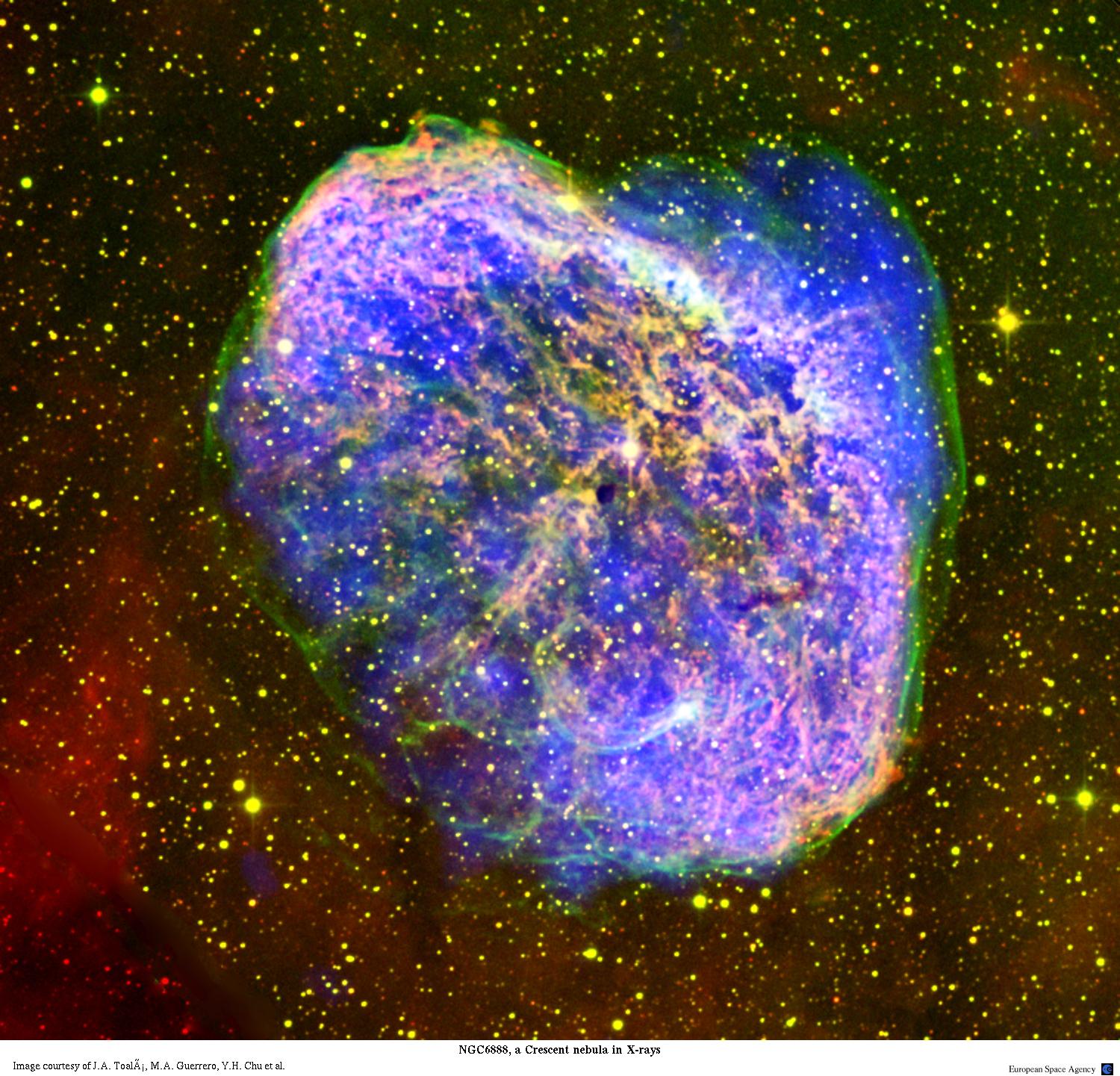
Minimum credit line: Image courtesy of J.A. Toalá, M.A. Guerrero, Y.H. Chu et al. and ESA. (for details, see Conditions of Use).
The image above can be displayed at full size and may be downloaded by clicking the image above.
| About this Image |
|---|
The Crescent Nebula in Cygnus (NGC 6888) is a circumstellar bubble blown by the stellar wind of the Wolf-Rayet star WR 136. The stellar wind is itself shock-heated up to X-ray-emitting temperatures, producing the so-called hot bubble. Taking advantage of the unprecedented sensitivity of the XMM EPIC cameras, this picture provides us with an impressive view of the diffuse hot gas (blue) inside the Crescent Nebula. This hot gas is confined inside the ionised nebular material, as depicted by the emission in the optical lines of H-alpha (red) and [O III] (green) which tells us where is the bulk nebular material and regions of interaction with the surrounding interstellar medium, respectively. The Crescent Nebula is located in the constellation of Cygnus, exactly at a location in the sky that has not been accesible to XMM-Newton until very recently. We waited and waited patiently for more than 10 years until the precession of the orbit of XMM-Newton moved this patch of the sky within its range. We thank Don Goldman for providing the narrow-band optical images
Investigator(s): Toalá, J.A., Guerrero, M.A., Chu, Y.-H., Arthur, S.J., Tafoya, D., & Gruendl, R.A.
| For More Information |
|---|
- Read the Journal article
- Detailed description of this image
- Query XSA archive for XMM-Newton data in the field of NGC6888
- Astronomical database entries for NGC6888;
- Query NED for more images about NGC6888
- Query SIMBAD for more NGC6888 data
- For unfamiliar terms, visit the XMM-Newton Astronomical Glossary
| Instrument | EPIC | ||
| Observing Mode | Full Frame | ||
| Filter | Medium | ||
| Date of Observation | 2014-04-05 | ||
| Image size | 0.00 x 0.00 arcsec | ||
| Detailed Caption | NGC 6888 is a Wolf-Rayet bubble, i.e., the bubble blown by the stellar wind of a Wolf-Rayet star, the late evolutionary stage of massive stars before exploding as supernovae. The stellar wind from WR 136, the Wolf-Rayet star at the center of NGC 6888, has swept the circumstellar material and carved a bubble around the star. The strong shock of this stellar wind with the circumstellar material heats the stellar wind up to X-ray-emitting temperatures, producing a hot bubble. The XMM-Newton EPIC cameras stared at NGC 6888 for 76 ks to produce the most sensitive and complete view of the spatial distribution of hot gas inside the nebula. To compare the spatial distribution of hot gas and nebular material, we have produced this colour-picture using H-alpha (red) and [O III] (green) narrow-band images obtained by the amateur astronomer Don Goldman. The hot plasma is well confined by the shell depicted in the optical emission line of [O III], which is very sensitive to the shock of the nebular material propagating through a low-density medium. At the Northwest (top-right), the highly pressurised hot gas has found a weak point in the surrounding medium and is leaking through a blowout feature. Most X-rays are emitted in the soft band, between 0.3 and 0.7 keV, but some additional emission in the energy range between 0.7 and 1.2 KeV is detected at the Northeast and Southwest tips of the nebula. This is the first time that spectral variations are detected within a Wolf-Rayet bubble (actually, within a hot bubble if we consider all available X-ray observations of planetary nebulae). These reveal changes in the plasma temperature and/or N/O abundances variations that imply spatially-varying efficiency of the mixing of hot and cold materials along the nebula. | ||
| Alternate Resolutions | (Help) |
|---|
This image is available in the following downloadable versions: Higher resolution versions of this image may be available, please contact the XMM-Newton HelpDesk.
Search the Image Gallery
To search the Image Gallery for a particular object, fill in the object name in the box below and click the Submit button.To search the Image Gallery for other images, fill in any of the fields below and click the Submit button.